Saturday, October 15, 2011

In search of YORU TO, and YOREBA and KAGIRI

I realize that I have very few days between now and when I take my JLPT, so I'm going to start doing something EVERY day, and if I can, double up on grammar points. So today's inexorably long post is going to be dedicated to YORU TO/ YOREBA and KAGIRI (HA/DEHA). Both are found in volume two of Time Stranger Kyoko by Arina Tanemura.


I used to be a huge fan of Arina Tanemura, even if I could hardly tell her main characters apart. Then, her type of love story started to get a little old (the basic love story is "hate each other than fall in love" which has been her MO for everything except FOS). She is famous for Kamikaze Kaitou Jeanne, a story about a magical girl who is the reincarnation of Joan of Arc with inexplicably Japanese-styled clothing for her seifuku, and Full Moon o Sagashite, a story about a girl with a beautiful voice who finds out she only has a year left to live and tries to fulfill her dream of becoming a pop idol.

It was once said that Time Stranger Kyoko was Tanemura's favorite work, something I think is true... for the beginning at the very least. What starts out as a fun magical girl manga about a princess who's trying to collect the 12 Strangers so she can awaken her twin sister Ui soon becomes a rushed affair with very poorly constructed twists. I think this is because Tanemura-sensei got the idea for Full Moon o Sagashite and felt the need to wrap up Time Stranger Kyoko as fast as possible. That is just supposition, mind you, brought on by the fact that I wanted TSK to be longer.

1. YORU TO/ YOREBA

First off, I need to make sure you don't ever get this mixed up with NI YOTTE! They have the same root, which is "depends/according" but they are used very differently!

But let's start with the easier of the two, YORU TO/ YOREBA. This grammar point is used when you want to say "according to so and so, this is the truth". For example:
  • ブームによるとJLPTのため勉強していることが楽しいだけど。。。
  • Acording to Boom, studying for the JLPT is fun...

So basically, it's NOUN + YORUTO + Whatever the Noun says.

Shall we to the manga?

The phrase I want to use is in the right hand corner, and is cut off... Sorry!

I'm going to put things in context really quickly here in order to move things along. Kyoko has discovered that the 12 Strangers she needs to find are leaders of various clans. For example, she's of the Royal Clan, so she's a Stranger. Her best friend is of the Flower Clan, and her romantic interest is the leader of the Dragon Clan. Both of them are Strangers. She then goes on a journey to go find more Strangers so she can use their power to wake her dormant twin sister. Of course, she's only doing this so she doesn't have to be a princess anymore, so it's not like she's really all that much of a philanthropist despite the good deeds she manages to do in every chapter.

So, the sentence in question is this: 

  • でもウワサによると仲の良かった2つの村が最近になってケンカばっかしてるみたいなのよね。。。
  • Demo, UWASA ni yoruto naka no yokatta futatsu no mura ga saikin natte KENKA bakkashiteru mitainanoyo ne.
  • But according to rumour, it looks that these two clans who have always had good relations are bickering. 

Yes. I was a little liberal with the translation. But I kept what was important. Moving on.

So using YORU TO and YOREBA is really easy. Forgive me for repeating myself, but it is just:

  • Noun(A) + NI YORU TO/ YOREBA (B) + rest of sentence(C)

This makes:
Rumour (A) NI YORUTO TO (B) + (They are bickering) (C)
According to rumour, they are bickering. 

I'd love to go into the distinction between YORU TO and YOREBA, but I have a lot trouble already trying to distinguish between "if" as in TO and "if" as in BA, so I don't think I'll be any help. Sorry. If someone could enlighten me, though, I'd be forever grateful!

2. KAGIRI 


KAGIRI has three uses. Fantastic. Are you ready?

The kanji for KAGIRI is 限り, which means "limits" or "bounds". What this should give you an image of is that whatever it's describing, it is no more than that. It is used in these three senses:

  • 1. As long as
    • This should make you think of SAE BA a little bit, but the image is a little different. Here, it's like until that limit of something is reached, something will stay the same:
      • 日本にいるかぎり、チンさんはわたしに連絡してくれるはずだ。
  • 2. Within the limits of
    • This is a description of where knowledge comes from. It's often used with 私が知っている限り, as in "as far as I know". The text book has a great example that takes this further and it uses 電話で話したかぎり, which sort of means "as far as he said on the telephone."
    • So, really, the translation is probably almost uniformly "as far as"
  • 3. Up until
    • This actually translates as "as far as" most of the time. Like, 能力のかぎり頑張ります. "Up until the end of my talents, I'll try." Ouch. That reallly sucks in english, huh?


As for context, it's a whole lot of spoilers, so I'm not going to give you it. I don't know if it's that important. It also has nothing to do with the mysterious guy smooching her. The king, on the previous page, is talking about events and his last thought ends as she's waking up to be orally violated.

I will say the king talks a lot about how she has powers like Chronos, and that awakening her sister doesn't mean she'll escape her fate. This isn't a spoiler, I swear, because he doesn't say what fate and it's strongly insinuated that it's her fate as a princess that can't be escaped.


  • 「みんなを守りたい」と思うかぎりー。。。
  • "Minna wo mamoritai" to omou kagiri-...


What sucks is that this sentence doesn't end, which makes it an absolute crap example sentence. Why did I use it then? Well, I'm getting desperate. The test is coming up soon and I need something! Plus, this really challenges my way of thinking about KAGIRI so it's good that I have to think this through.

But first, I want to show this absolutely hilarious translation.


And this is why we DO NOT use online translators. Either that, or we only use translators whose language that it is going to be translated into is their native language. First off, that first sentence is about how Kyoko's hair will change back from red to brown. There is another sentence in there that uses DARAKE (魔族だらけの未来) where he says a "a future full of demons".... but according to this, the Mazoku went to the future where Ui's moment of awakening vanished! 

But I'm digressing. 

Let's look at the three translations for KAGIRI. There is "As long as", "As far as" and "Up until". Which is best here?

Well, I for one, agree with the translation above. It is "'Everybody defended' and to think as much as possible". Oh, wait, no I don't! That's ridiculous! I mean, it suggests that there is a limit, so that's good, but other than that, WHAT THE HECK?!

I'm going to let you in on a little secret, it's not definition 3. That leaves us with 1 and 2:

Previous sentence: "After all, you can't escape your fate of awakening Princess Ui." (結局おまえは憂を目覚めさせる運命から逃れらないのさ) 
  • 1. As long as you think that you want to protect everyone...
  • 2. As far as you think you want to protect everyone...


So which one of those sounds right? That's right! One! It's inverted sentence! Oh Japanese, how you love to toy with me.

"After all, you can't escape your fate of awakening Princess Ui... as long as you think you want to protect everyone."

In a normal, formally written sentence using KAGIRI, this would be flipped like this:

結局、「みんなを守りたい」と思うかぎり、おまえは憂を目覚めさせる運命から逃れらないのさ。

I'm a little hesitant to end this post because it makes me feel so nostalgic. I remember ten years ago when the first chapters of this came out. I bought the manga for a exorbitant price online, and muddled through with .txt translations because I had no idea how to speak Japanese at the time. Sometimes, I wonder if child self would be impressed with me. Other time, I wonder if child self isn't a little disappointed that I'm not further along.


Friday, October 14, 2011

End of WAKE WEEK : The summary

It's the end of WAKE week. It shall no longer be wacky!

It should not surprise you that I find it incredibly difficult to write this while listening to audio plays. Nevertheless, I'm not really going to stop.

I was going to pretend they are Japanese audio dramas (which you can find a lot of, but that's really a blog for another day), but it's not true. It's totally Doctor Who. And I love the Eighth Doctor.


This totally has to do with Japan, right?

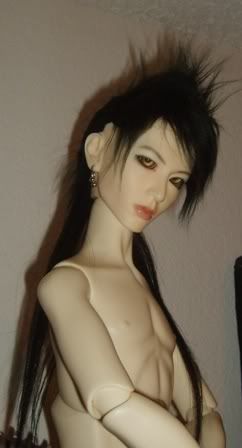
But if you don't believe that I can relate this to Japan, you are talking to the wrong million-track mind. Take a look at this image of the eighth doctor here on deviantart (if you're at all curious, you can view my artwork at mapend.deviantart.com). That is a Dollzone Yuu, which is a Chinese ball-jointed doll. There is a Japanese version of this sort of thing called the Super Dolfie. What is is a custom doll that you can change the clothes, hair, makeup, and even hands and feet on. There is a second hand market for it, though I've never actually been witness to it. I do know they are expensive though. I've been to one of the stores. I can also tell you that they do not let you take photos of anything.

I imagine if you can think of a celebrity, they have a Super Dolfie. Let's try the ones mentioned on this blog shall we?
Gackt  - yes  
Miyavi - yes (source says this is wig mod she was working on)
Sawada Kenji - no

Okay, that's where I stop. It turns out I'm wrong since I can't find a Moriyama Mirai one, or anyone else that isn't visual kei for that matter. So I should say, as long as it's a visual kei artist, I'm sure you can find a Super Dolfie of it. This is not surprising though. You usually find Super Dolfies in Visual Kei districts of cities. The ones I've been to are usually mixed in with the VK fashion stores of a shopping building.

You didn't think I could do it, did you? You didn't think I could twist British culture into something Japanese. Of course, why I'm talking about them at all doesn't really matter except that I'm listening to Doctor Who radio dramas while I write this. They certainly have nothing to do with this grammar point.

What I actually should be talking about it WAKE, WAKE DEHA NAI,  WAKE GA NAI, WAKE NI HA IKANAI. Why? Because they all have WAKE in them, and they are easily confused. I've have done a post for each one and are linked accordingly.

What I want to do here is  just go over the four of them together, just to really solidify how you use each one. After all, if you're anything like me, you had to do something like this:


Or not.

Anyway, the first thing is that the kanji for WAKE is 訳, which is one of many Japanese words that mean "reason". At least, that's what my dictionary tells me. Jim Breen goes a bit further, and says that its "conclusion brought on by a specific reasoning", which as complicated as it is, is actually more pertinent. Therefore, it's pretty important that you keep that in mind when you try to separate out these three grammar forms.


  • WAKEDA
    • as you know; the fact is that; the truth of the mater is that~.
      • Very similar to のだ。
  • WAKE DEHA NAI
    • It doesn't meant that~; I don't mean that~; It's not that~; It's not the case that~.
      • used most often with というわけ
  • WAKE GA NAI
    • There is no reason why~; It is impossible for it to~; cannot;
      • Very similiar to はぜがない
  • WAKE NIHA IKANAI 
    • cannot; cannot but; cannot help~ing; haven o (other choice) but to~.
Obviously that is it in a nutshell, but let's discuss ways to remember, shall we?

  • WAKEDA
    • DA/DESU is an expression that is closest to "to be" there for it is saying it as a simple fact. 
    • WAKE DA = It is this conclusion that I have reasoned.
  • WAKE DEHA NAI
    • DEHA NAI  means that is doesn't exist. Naturally, it is the opposite. Here, you are saying that there isn't a good reason for someone to think something.
    • WAKE DEHA NAI = That is a crappy conclusion you've come up with. Well, okay, it's probably a bit nicer than that.
  • WAKE GA NAI
    • GA NAI  means that there is no reasoning or conclusion. It's very similar to the one above, but I think it's best to tackle this using my arch nemesis, Literal Japanese. The first one uses DE HA NAI, which essentially means that it doesn't exist. GA NAI is the informal way of saying ARU, which means that you don't have it. Well, not necessarily you, but you get the picture. 
      • I honestly think that subtle different is that the first one sort of implies someone is being foolish, such as saying such a reason DOES NOT exist, whereas the second one is more or less saying that the subject in question alone doesn't have the correct reasoning. 
  • WAKE GA IKANAI
    • IKANAI is "won't go", so it's basically saying that the certain reasoning won't fly. 
      • This is strongly influenced by how you use negative and affirmative statements.
      • It more are reflects a statement of being able to do something. Like: Because I have to drive, there's no reason for me to drink.

Well, I hope this, in tandem with the other four posts I've dedicated to the word have helped a little. If not, ask away! I will endeavor to be clearer!

Thursday, October 13, 2011

WAKE WEEK! In search of WAKE GA IKANAI

That's right! It's day four of WAKE WEEK!

Okay, I'm going to talk about this using a video I snagged off of Nico Nico Douga, which is sort of the Japanese youtube. It's an easy enough site to join, and if you're registering in America, it conveniently does the process in English for you. Coherent English, mind you! It's sort of baffling...

In any case, the site has this annoying thing where it displays the comments on the actual video, which is why you see so many "w"s. For those who don't know "wwwwwww" is the equivalent to "lolololol". One "w" is just "lol". The reason is because the kanji they use for lol is 笑, which means "laugh". 笑 starts with the letter w, hence the millions of ws.


 So the video is called:

  • 死にたいけど、まだ死ぬ訳にはいかない理由
  • Shinitai kedo, mada shinu wake niha ikanai riyuu.


WAKE, as a said every post before means reason, more specifically a reason that draws conclusions. The definitions I have for WAKE NIHA IKANAI are as follows:

  • Cannot
  • Cannot but~
  • Can't help ~ing
  • Have no (other choice) but to~


My notes say that it's like KOTO GA DEKIRU and NAKAREBANARANAI and NAKAREBANARENAI, which is weird because neither of those really have anything to do with each other. The first is "to be able to" and the second is "have to/must".

So, I think that I meant that it's sort of a mix between the two. I don't know. Sometimes I wish I could ask past me questions....

My example sentences are like this:

  • これから運転しなければなりませんから、お酒を飲むわけにはいきません。
  • Kore kara unten shinakerebanarimasen kara, osake wo nomu wake ni ha ikimasen.
  • Because I have to drive from now on, there is no reason for me to drink.


  • この論文が重要だから、読まないわけにはいかない。
  • Kono ronbun ga jyuuyou dakara, yomanai wake niha ikanai.
  • Since this is a principle thesis, I have no other choice but to read it.

*Please note on the first one, I put it into the more formal form. 

Therefore, the WAKE NIHA IKANAI functions as way of reasoning that there is no other choice than what will be done.

Even though I want to die, these are the reasons I have no other choice but not to die. 
It's a bit convoluted in English, I agree. But whatever. The SHINU doesn't seem to have a negative added on to it, but as you watch the video it's pretty obvious that it's reasons why people won't kill themselves yet, such as "I haven't had sex yet" or "I want to play hentai games every day". Also, MADA usually indicates a negative statement regardless if the verb is negative or not, so I'm relatively sure I got it right.

At first I thought the video was about suicide in Japan, because it is a serious issue there. Trust me, I lived near a place that was famous for suicides, and it had lots of signs hanging around that said "you parents love you" and "it's just a test" or "there is still a future". They are more than a little disturbing, especially when they are strewn about a place that has been abandoned due to a bad earthquake. I am talking about Seikinohana in the Ishikawa prefecture. 

It's weird to me that such a serious issue can be made into a joke. Don't get me wrong, some of them were pretty funny. But the thing is, it's done in the style of the classic Japanese BBS, specifically using 2ch as its platform. I was going to blab on about it a bit more, but it turns out that wikipedia totally talked about everything I wanted to, right down to Densha Otoko! That movie is famous for the love story that comes into being because of BBS (the main character gets encouragement from the people on the BBS).

In any case, the reason why it's sensitive, in my opinion, is that it is common for people who wish to kill themselves to come to these boards either as a cry for help because they can get no one in their life to listen to them, or because they want to find other people who also wish to commit suicide. I'll quote an article from Wired:


Mass suicide: Last December, an anonymous post began a thread with this simple message: "28 years has been enough. I live in Hiroshima. I plan to die within the month. Will somebody come with me? I don't have the courage to go alone."
More than 700 messages follow. "Take a nap," one says. "What's wrong?" another asks.

"My college girlfriend was gang-raped, and she killed herself. Plus I have over 4 million yen in debt," the guy responds before disappearing completely from the forum. What happened to him isn't known, but the conversation continues among other suicidal hopefuls, self-hater-haters and gentle negotiators. The last post, published just a few hours ago, is a goodbye note by a woman who betrayed her lover. The conversation is one of many mass-suicide discussion threads.
So, I'm a bit torn about this video... mostly because I know that I shouldn't find it funny knowing what I know. But I also think that humor is based in the absurd, and this isn't making fun of the seriousness of the issue, but the absurdity.


Wednesday, October 12, 2011

WAKE WEEK! In search of WAKE GA NAI

Why yes folks! It's day 3 of WAKE WEEK!

And we arrive at WAKE GA NAI, which is very very similar to WAKE DEHA NAI. We're going to have to try and discover how this one is different together, or in a more likely way, I'm going to stumble about for a full five hundred words.

Today, I'm going to go on the fall back of anime, and talk about 俺の妹がこんなに可愛いわけがない, or Ore no Imouto ga Konna ni Kawaii Wake ga Nai. It's usually abbreviated at Oreimo, which I always think sounds like "I'm emo"。。。

何で誰でも俺の友達なれん??

。。。but that is probably just me. The English dub will be named Oreimo as well, and this post seems to be quite fortuitous because it's going to be released in five days! Check out the aniplex website here.

WAKE GA NAI translates as the following:
  • There is no reason why~
  • It is impossble for ~ to~
  • Cannot ~

As you can see, it's not the easiest thing to translate. The way this anime series is usually translated as, then, is:

There is now way my little sister is that cute! 
Really, that is the best way to go about it. It's not like it's fluid English to say "It's impossible that my little sister is cute" "Or there is not reason my little sister is cute", though both of these are a bit more true to the original feeling behind the grammar point. I suspect that no matter how you translate the title though, it will always sound a little silly in English, and that's why the Aniplex chose Oreimo. I'm sure that's what happened with Saikano. My Girlfriend, the Ultimate Weapon really isn't going to get the demographic that anime is actually meant for, which is people who likes stories about love during the destruction of the world. With the actual translation, you just get a lot perverts who like making love to the barrel of a gun.

Anyway, you'd think that with a title like "There is no way my little sister is that cute!", the anime/manga/novels would be about a guy who is uber protective of his sweet sister who attracts all sorts of guys, or about a guy who can't figure out why all his friends fall in love with his sister. These are reasonable guesses. They are, however, wrong.


Let's join me for another episode of Weird things from Japan!

Ore no Imouto ga Konna ni Kawaii Wake ga Nai is about a brother and sister who haven't gotten along for years. That is, until the brother discovers that his sister is into hentai games, or eroge, specifically ones about little sisters. Somehow, the brother becomes convinced that he has to help his little sister hide her weird hobby so she can be herself. I'll be honest, I'm not real fond of the series. It really plays on the sister-love theme too much, and the sister's actions (despite her swearing that she doesn't want to have sex with her brother) are just too... erotic and inappropriate. It's also filled with scenes of her in her underwear, or her with her butt in the air... or her with her skirt blowning up... or... you know, I'm just going to stop.

I'm not sure how it is in the books (which the anime and manga are based off of), but I really just don't get it,  nor  do I think it is something that you're even supposed to get. The one redeeming quality of the series is that the little sister is emphatic that 2D and 3D worlds are separate, meaning reality is reality, and fantasy is fantasy. It's stupid to mix them up, she says. I almost wonder if isn't a comment on readers like me, who still think the story is pretty needlessly perverted. I'm just not realizing that none of it is sexual because of the reality of the situation which is... she doesn't like her brother that way. Or something like that.  But you know what? I'd like it to be explained to me why it's necessary to keep placing her in the role that she enjoys watching, but has no desire to play. What I mean is that she plays a little sister sex object though she claims she isn't. For example (and I will not put the image up) she falls down at one point which somehow perfectly pushes her skirt and blouse up to show her bra and panties, and her brother is straddling her because he fell down too. Seriously. Explain that.

It's not that I think the story is horrible (it has interesting point about what are acceptable hobbies and why ordinary seeming people have fetishes) but the scenes are just needlessly perverted beyond all belief. And this is coming from someone who

I feel, though, that I have not successfully described WAKE GA NAI to you, so I'm going to add just a smidge more. In my two year old notebook, I have these two sentences:

  •  こんな優しい仕事が君に出来ないわけがない。
  • Konna yasashii shigoto ga kimi ni dekinai wake ga nai.
  • There's no reason why you can't do such an easy job.
  • 日本語がそんなに速くマスター出来るわけがない。
  • Nihongo ga sonnani hayaku MASTAA dekiru wake ga nai.
  • It's impossible to learn Japanese that fast.


These sentences have an important distinction. Do you see how the first is negative with a negative? Well, Japanese is a lot more carefree about their double negatives, though as a hobby linguist and grammarian, I see very little wrong with double negatives so long as they aren't completely muddled. But the truth is, us English speakers try to avoid them. Japanese people, however, love them. I think it has to do with misdirection in a language that is filled with implication and ambiguity. The second sentence has an affirmative and a negative, making a nicer English sentence. I just want you to know it's possible, and indeed even encouraged, to use a double negative.

So, in the end, I think that the general way to use WAKE GA NAI is to suggest that whatever the sentence is in front of it is, that sentence is impossible, or at the very least, very stupid.

How to make a WAKE GA NAI sentence:
  • Plain form form of whatever, unless it's a noun then add DEARU/DATTA + WAKE GA NAI
    • what you're talking about + it's impossible to do what you're talking about

I assume to make this more polite, you would probably say WAKE GA ARIMASEN.

Tuesday, October 11, 2011

WAKE WEEK! In search of WAKE DEWA NAI

Hey! We're continuing WAKE Week here with Day 2! WAKE DE HA NAI.

The wacky thing here is that I'm not going to talk about pop culture in any way. Well, probably. Let's just see as we go, shall we?

As I have said, WAKE means "reason", so that can help you figure out what this grammar point means. I'm not really going to lead you through a long confusing mess today, so I'll just say the following translations (though it is not certainly limited to these) are frequently used:


  • It doesn't mean that~
  • I don't meant that~
  • It's not that~
  • It's not the case that~
  • It's not like~


What I have in my notebook for example sentences are:

  • 君の考えに反対するわけではないが,そのやり方でうまくいくだろうか。
  • Kimi no kangae ni hantai suru wake de ha nai ga, sono yarikata de umaku iku darou ka.
  • I don't mean to oppose your idea, but I wonder if things will go well with that approach.

  • 失敗というわけではない。
  • Shippai to iu wake de ha nai.
  • It doesn't mean it was a failure.


Those should give you the general gist of how WAKE DE HA NAI is used. I should mention that the second form which uses TO IU is a very common way to use WAKE DE HA NAI. It just sort of reinforces the "doesn't mean" with a "really", like "it really doesn't mean that". Imagine that in a sympathetic voice, and we're set!

 The website I'm going to use seems to be a sort place dedicated to things that make people go ふ〜ん (fuuun, pronouned fooooon), which is a hard noise to describe, but I'm pretty sure that disappointment is a large part of it. The post I want to talk about has our grammar form three times, so we're going to go over it! But first, take a look at a screencap!


In case your wondering... yes, I inserted myself in my own very special way of internet tourism with the ubiquitous Japanese peace sign. Love it! I may or may not keep doing that.

Anyway! The three ways the website above use WAKE DE HA NAI are:

  1. 飯田橋の「いいだべぇ」はなまっているわけではないらしい.
  2. JR飯田橋駅のガード脇橋脚に「いいだべぇ」の文字が。調べたところ「飯田橋」と「あかんべぇ」を合わせたとのことで、なまっているわけではないそうです.
  3. フォントは、壁に描かれているクジラの絵と合わせて、クジラをモチーフにしているそうです。でも、なぜ「あかんべぇ」なのか、海が近いわけではないのに、なぜクジラなのか。


So, here's the deal with this post. By Iidabashi Station (a station I'm sure you've at least transferred at if you have ever been to Tokyo) there is sort of mural of whales with the phrase "Iida Bay". What makes this person say ふ〜ん is the fact Iidabashi is nowhere near the ocean. There is a bit more to it than that, but it would spoil the fun of going through the sentences.

Though they use it three times, I must confess I really don't know how to use this word nameru.  I know that word means to go soft, to get duller, or to decrease in something. I hate admitting it, but I literally don't know how to translate those first two sentences despite that I get the gist of them. I'm not really sure, though, that Iida Bay is supposed to be a mix of akanbee, which is the act of sticking out your tongue and pulling down one eyelid, and Iidabashi like the second sentence suggests. I think it's likely an odd usage of hiragana to say that it's a bay, and that's why the whales are there. That being said, it may have do something to do with this song, Akkanbe Bashi:


I fear I may be out of my depth for once, and I find this too weird of question to ask my Japanese friends! Though... they probably should be used to it.

In any case, the third sentence translates as this:

3.  The font, along with the picture of the whale, seems to have a whale motif. But, why "akanbee"? It's not like the ocean is close, however, why a whale?

So there you go! 


Monday, October 10, 2011

WAKE WEEK! In search of WAKE DA

Guess what guys! It's going to be a わけ week here at JLPT Blues.


This week is going to be dedicate then, to all the grammar forms that involve WAKE, which is WAKE DA, WAKE GA NAI, WAKE DE HA NAI, and WAKE NI HA IKANAI. That's right! Five days of crazy, WAKE fun!

But let's start with the easiest to explain, and the one that will help us go onto understand the other grammar forms.

The kanji for WAKE, though it is rarely ever used in the grammar form, is 訳 which means reasoning/reason.  So immediately, we can surmise that it means whatever it is, we use this grammar point to explain the reasoning for this. Here are a just a few of the translations of WAKE DA:


  • As you know, ~
  • The fact is that~
  • The truth of the matter is that~


So really, in attacking this form, you just have to get the general idea of feeling behind it. My notebook from a few years back has this pretty useless sentence:


  • 私の責任であるのわけだ。
  • Watashi no sekinin de aru no wake da.
  • As you know, it's my responsibility.


I don't really find that particularly helpful, so I had to go on a search for it. I struggled finding this grammar form in a fun way, so we're just going to talk about Japanese ad campaigns and domestic tourism. Fun, right?


Now, if you travel around Japan, you will find more than your fair share of posters like this at train stations. This poster, actually brings back some pretty vivid memories of walking over the bridge at Hakui Station. Generally, these posters are dedicated to domestic tourism, and they are usually on the train line for whatever they are trying to advertise.

This particular poster is featured on the blog of a hotel called the Sakurai which is located at the Kusatsu Onsen in the Gunma Prefecture. If you read the link I provided for the onsen, you would think it was the most famous place in all of Japan, though I have to admit I've never heard of it. That, however, is generally the way of tourists attraction in Japan. Everything seems to be world famous... But before I go into that, I need to say that I'm in no way an onsen connoisseur so it may well be famous. I'm usually forced to go, and the only time I ever had fun at one was when I went to Odaiba Onsen because it was Edo style.

あきちゃ〜ん!会いたいよ!アメリカ行ってくれね〜!

In any case, most town's in Japan survive on domestic tourism, and the only way to get people to come is to have something that no one else does. This is why you see lots of posters boasting things like 名物 (meibutsu) which is a sort of specialty food. It's like how Nagoya has Miso flavored donkatsu, Hiroshima has a special kind of okonomiyaki, and Hokkiado has its own type of ramen. Barring that, they try to have something else that is world famous. The Hakui I mentioned earlier is, interestingly, the unofficial UFO capital of the world. You can even get UFO themed ramen there!


My Japanese hometown had the world's longest bench. At least, that is what the sign says. In fact, it's the third longest bench. Also, at the souvenir store at the base of it, you can get the specialty Togi ice cream, which is potato flavored. They give you a salt shaker to put salt on it even!


That's me surveying the length of the bench, and my bud Davin enjoying potato ice cream. The other two aren't enjoying the magnificence of my bench so let's ignore them.

Someday, I'll dedicate a full post to domestic tourism, but I think it's high time I stop reliving my Japanese double life and return to the topic at hand. The poster's phrase is:

  • そりゃ、涼しいわけだ。
  • Sorya, suzushii wake da.


I'm hesitant to translate this because suzushii is such a weird word. You usually hear it when you fan someone's face, if there's a nice cross breeze in your house, or if a breeze picks up and cools you off on a hot summer day. And yes, it is that specific of vocabulary. So, the literal way to say this is "That's cool, you know."

But I'm going to say this:


  • It's a breeze, in fact.


Ok, so I interjected an English pun in there. So what? Yes, having taken French translation courses, I know you're not supposed to add, but I'm not professionally translating here, am I? I win.

And bonus points for those who have the same mind as I do and immediately thought:

Leave it! It's what they read.

Ah man, gotta love The Birdcage.

The reason the ad says this is because, if you read the blog, summer in Tokyo can be painfully hot. This, having spent two summers in Tokyo, I can attest to. It also is saying that it's cooler up in the mountains where the onsen is (1200 meters up, in fact) so it's an excellent place to escape the heat (by jumping into scalding hot water?). All in all, it's a nice little promotional poster to say, despite what you may have thought about coming here, you should get your butt up here! It's only two hours away in the Gunma Prefecture!

The structure of WAKE is as follows

  • Sentence in plain form of which every tense (na for a na adjective is necessary) + WAKE DA.
  • Noun + DE ARU/ DATTA + WAKE DA

Before I go though,  I think it bears to mention that WAKE DA functions a lot like NO DA, which, if you are old school anime person like me, means you probably recognize it from this guy:


This is Chichiri from Fushigi Yuugi, who generally ends every sentence he says with NO DA. Some people mistake this as some sort of dialect (like Tokyo-ben, or Osaka-ben), though I'm certain I've never heard of anyone except Chichiri ending their sentences with NO DA as a matter of accent as opposed to meaning. In any case, it's translated very annoyingly in the dub as "you know?", and left relatively untranslated in the sub. At least, as far as I remember. I'm really not interested in rewatching the series to find out. Though, I would have translated it as "actually", I'm not sure if that would make him sound less annoying. Wow, you would never believe he's one of my favorite characters from the series, would you?

But since I'm not into rape fantasy like Yuu Watase, I'm not really going to go details about the series. (That comment is going to cost me, isn't it?) It's weird, my distaste for the show, when I absolutely loved at age fifteen. I even painstakingly scanned in every page of the artbook, such was my dedication. I wonder where I put that, come to think of it...

Tomorrow, look forward to WAKE DEHA NAI!

Sunday, October 9, 2011

In search of NI KUWAETE

Yesterday,  I talked about Takarazuka a little, but I didn't really go into it much further than their fans take them very seriously. Well, I should say most fans. I am a fan (even a member of the livejournal community), but I don't think I'll ever be as protective of it as others are. I like it. I've bought a few DVDs, and few GRAPHs, and I own a program for every show I've been too. But I'm not a very good fan. I don't know every actresses name, and I don't pick and choose ones from the graduating class and cheer them on hoping they finally get the vaunted position of Top Star.

Which brings be to the next thing I want to talk about when it comes to Takarazuka. Since it is an all female musical troupe, naturally they are divided into girl and guy parts (musumeyaku and otokoyaku respectively). Once your part is decided there is NO switching. Since the boy parts are more popular, these are the parts that are most sought after, which I think speaks of a very special sort of sexism. Also, if you're chosen to be an otokoyaku, you must dress, act, and speak like a boy for the entire duration of your tenure at Takarazuka.

Do not be fooled into thinking that having an all female troupe is feminist or progressive. It is not in answer to kabuki, the famously all male theatre styling of Japan, but merely a marketing ploy by the owner of the Hankyu Corporation who was trying to get more people to use his trains by making Takarazuka a destination. The entire board is filled with men, and the people who make the decisions are all men. What's worse, females are always portrayed as helpless, whereas the males are always their only hope for whatever they need solving. The first play I saw, I thought "well... it could just be this one play"... the second play I saw, I thought "Well, maybe it could be two in a row." Nope... it was the theme for all of them. Even when they did the famous German musical, Elisabeth, they transformed the strong Elisabeth and her love affair with death, into a frightened woman who threatens suicide and is always crying out for help. Granted, the Takarazuka Elisabeth is a million times stronger than that of other Takarazuka female parts... but still... it irks me.

But that's probably because Elisabeth is my favorite musical of ALL TIME. O_O ALL TIME.

In any case, the goal is to be Top Star, which is reserved for a couple, with the male lead always, always, ALWAYS outshining the female lead. Honestly, I don't remember a single name of a musumeyaku, and that's more than a little sad to me. In any case, when you are the lead couple, you get the lead no matter what, which goes against my very American way of thinking. Sometimes I think the star is great, but there are other times I think that someone else in the cast would have done a far better job. The casting is just so Japanese in its way of thinking, it's a little hard to understand.

Today we are going to talk about Elisabeth because that is what I happen to be watching, and that is which program I happened to be flipping through when I found the grammar point.


I put the German video clip first to give you a comparison. The sexuality of the both of the songs is so present, yet so different in the videos. I'll also say, just for the hell of it, that Death in the German version is far less coercive, and takes part very rarely. He watches, and lets Elisabeth make her own decisions.

I got to see the performance of Elizabeth with the incomparable Sena Jun, and I got the program guide for it. Every guide has a summary of the story, a more detailed account of the scenes, head shots and photoshoots of the cast, and interviews with the people involved. And sometimes, if you're very lucky, they have the summary in English on the last page. The first time I went you could just pick up a piece of paper that told you what was going on. After a few times, I noticed they were no longer there. I wonder if it was their way of trying to sell more programs to have the English there, or if (since they don't all have translations) they just stopped paying a translator. Who knows.

This is an interview with Hiromu Kiriya, who at the time was not yet Top Star and playing Franz Josef. Now she's the lead in Moon Troupe. Goodbye Sena Jun!


  • 多くの方がご存知の作品であることに加えて、二度目の挑戦ということでプレッシャーのですが、一つ一つ丁寧に取り組んでいきたいです。
  • Ooku no kata ga gozonji no sakuhin de arukoto ni kuwaete, nidome no chousen to iu koto de PURESSHAA no desu ga, hitotsuhitotsu teinei ni torikundeikitaidesu.


I know. I know. It's a lame setence. It's no fun at all, and I obviously only chose it because it meant I could rant about Elisabeth. I get it, that sucks. If I find a more interesting way to use KUWAETE, I will do another post. But for now, this will have to do. I scoured everything, and there was no JLPT II grammar forms! Well, except for KUWAETE.

So, this grammar form is going to be beyond easy, something you will soon realize when I tell you that KUWAETE in dictionary form is KUWARU (加える), and that means "to add".

Yup. You guessed correctly. NI KUWAETE means "in addition to".


Before we get to the translation, I think it's important to talk about what the context is. The gist of the interview is that Hiromu Kiriya had already played a part in Elisabeth (it doesn't say who, but I know it to be Luigi Luchieni, thank you very much TakaWiki), and what sort of character Franz Josef is.

Knowing this ought to make it easier to understand the setence:
  • In addition to lots people knowing the play, I have a lot of pressure from the challenge of acting in the same play twice, but little by little I want to tackle it thoroughly (carefully).

Yeah, you know what... even I recognize that this is pretty lame... I will definitely find a better example someday. But for now, dream of little deaths dancing.